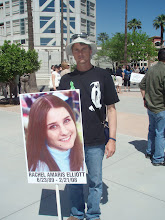
Showing posts with label Steven Elliott. Show all posts

Sunday, August 7, 2016

Independence Day


Elva Diaz was released from prison over a year ago, July 4, 2015. I wanted to write about it then but couldn't find the words. We always knew the day would come, that there was a date on the calendar somewhere that would forever mark the day of her release. I can't help but feel it is some kind of cruel irony that it turned out to be Independence Day.

By the State's calculus, Elva Diaz was credited with double time for time served of her 10 year sentence for Gross Vehicular Manslaughter. She spent over a year in county jail awaiting trial. So, after sentencing she spent 4 years in prison and was released on parole.

Hereafter, July 4th will be celebrated by Elva Diaz and her family as the day she finally paid off her debt to society for her crimes, was liberated from prison, and set free to begin a new chapter in her life. It means the end of the consequences she must suffer for taking Rachel's life. Elva's life will resume now much the same shape it had before the night of February 21, 2008. I'm still not sure what it means for us, but every year another celebration will be tainted with the memory of what we lost.

And that is just the way it is. And we, Rachel's family, must be learn to be satisfied and to let go of any desire for retribution. I still don't know what justice is, but I know that balance has not been restored. In a case like this, that was always an impossibility, though we may not always have acknowledged it.

The following is a transcript of text messages to and from a friend, transmitted on the date of Elva Diaz's release. The words of my friend are wise, and I have had over a year now to consider them. I'm not saying I am there yet, but they serve as a signpost for the way ahead...


7/4/15, 9:48 AM

Don't know if I told you, but Elva Diaz is being released today. They moved the date up to July 4th - Independence Day. Fitting for her but kind of a slap in the face to us. In any case, a new chapter begins...
Happy 4th!


7/4/15, 1:25 PM 

I hope this really does mark the end of a chapter for you both; say, the end of the Elva Diaz chapter. 
    If you never have to hear an update on this person again, if that chapter can start to close today, then this marks a kind of your Independence Day for you guys, and however she thinks of it is her own concern. 

    Goodbye, Elva Diaz. 
     

     And Happy July Fourth, my friends.

Saturday, May 4, 2013

Sand Sculptures


Jill and I spoke at a recent Every 15 Minutes program for Biggs High School. Well, really, Jill spoke, and I sat and tried to hold myself together.

The kids who participated in the program are the good kids. Good kids aren’t the problem. It was obvious we were preaching to the choir. 

Rachel was one of the good kids. She wouldn’t drink and drive, and she wouldn’t let her friends.

Still: she was killed by a drunk driver. 

I’ve been over it thousands of times in my mind. There was nothing Rachel could do to prevent it. She did all she could do. There was nothing I could do to save her. That night Rachel’s life was in Elva Diaz’ hands… Only Elva didn’t know it. I’m not really calloused enough to claim she wouldn’t have cared, wouldn’t have acted differently if she had known. Alcohol made her stupid and careless.

What message from Rachel’s story could we relay to a group of good kids that aren’t part of the problem? We have no assurances. We can make no promises. We were at a loss for words. 

You can prevent yourself from killing yourself or someone else by driving while intoxicated, which is sufficient reason. But there is nothing you can do to prevent a drunk driver from killing you. I’m not saying there aren’t things that can decrease the likelihood. You can stay off the road. You can stay home. But people have been killed in crosswalks, on the sidewalk, people have been killed by drunk drivers while they were sitting in their living rooms.

You can pray for protection. 

But we tried that too, and it didn’t work.

We could tell from their questions that most of the Biggs High School kids are Christians. We confessed to them our faith and our confusion, our anger and our sadness. They came up afterwards to console and encourage us. It was sweet and compassionate - a decent, human thing to do.

When Darryl Spessard shared the story of how the life of his precious daughter, Andrea, had been taken by a drunk driver with Rachel’s High School during the Every 15 Minutes event at Orland High School her Senior year, Rachel had reached out to him with compassion and sympathy. The very student that played the part that Rachel had played - the victim who dies at the hospital - came to comfort us as Rachel had done. 

Rachel was that exactly that kid. There he was, and Rachel was gone. I couldn’t help wonder what would happen to him...

We were asked what lessons we had learned. The assumption underlying the question is that there is some meaning, some greater purpose to Rachel’s death. 

What sprang to mind was Anne Lammott’s words from her book, Help, Thanks, Wow: “Any snappy explanation for suffering you come up with will be horseshit.” But that’s not what I said. 

I said something like, “I don’t want to leave the impression that everything that has emerged from Rachel’s death has been bad. We have learned some really important lessons, we have experienced some really good things, met some really wonderful people we may have not have otherwise. In many ways, we are better people than we might have been. But all these things have come at too terrible a price. We’d rather have Rachel.”

My answer was honest enough, I thought, but not too honest.

This I know: Life isn’t predictable or safe. Eventually, it will kill you.

I heard the mother of one of the victims killed by the bombing at the Boston Marathon say, “It’s such a waste.”

I know the feeling.

Since Rachel was killed I have been haunted by the fruitlessness of her life, the senselessness of her death - the tragedy, the waste of it. 

Her death was not only a waste of her life, but of mine. I don’t know if time is money - but it is life. I’m reading a book called, The Exquisite Risk, by Mark Nepo. He says, “...wealth is time, not money.” Time is the real, precious currency of our lives. 

I spent my time, my life loving Rachel, and now she is gone.

What do I have to show for it?

A sand sculpture erased by the tide. I kept the ocean to my back, forgot it was there. Perhaps I supposed this one so worthy and beautiful surely would be spared...

The question now with the tide coming in, is love a good investment?

I don’t like the way the way things turned out, but I’m still convinced time spent loving Rachel was not time wasted. I love her still. Grief is only love in distressing disguise.

I believe - and this is my belief - I’m not going to blow anyone up to prove its veracity: Time spent loving is life well spent. I believe love is never wasted.

The bargain of life and of love is death and loss. These are not unexpected contingencies. They do not and cannot present insurmountable obstacles to love. We do not cease to love because we know we will lose, anymore than we cease to live because we know we will die.

James Joyce said, “We have only this one short life in which to love.” 

The challenge of life is to find the courage to love in passing. To go, loving. To love and let go. There is no other way to love in this world. And no better way to spend whatever time we have left.

Thursday, December 6, 2012

Storytelling


“There was another life I might have had, but I am having this one.”
Kazuo Ishiguro - Never Let Me Go


It’s been nearly five years since Rachel was killed. Shortly afterwards, Jill and I had dinner with a couple who had lost their son nearly ten years earlier. I knew they knew how we felt because already the man had asked me questions I hadn’t told anybody were on my mind. The burning question, I think, for both me and Jill the night we had dinner was: “Will we ever get over this?”

From my current vantage point, I can see the foolishness of the question. Then, we hadn’t yet fully absorbed the reality of what we were facing: the rest of our lives without our daughter. We were desperate for hope from someone who had walked the road ahead of us. The couple answered our question as compassionately and honestly as they could. Ten years after his death, they told us, they still weren’t over the loss of their son. For as long as they walked this earth, they never expected they would be. The going get easier, but it never gets easy; the hurt gets better, but it never goes away. We should have known. They had learned to live without him, as harsh as that may sound. In Life of Pi, Yann Martel says, “You can get used to anything...isn’t that what all survivors say?” And while getting accustomed to the loss of a child seems at first unimaginable, undesirable, heartless even, it ends up, after all, to be sadly, horrifically...possible. Perhaps even necessary. Our hearts sank there at the table as we imagined the road ahead. We didn’t want to drink this cup, but drink it we would, together. A bitter communion. 

The man we had dinner with occasionally attended and preached at our church. He had formerly been an elder. I took his place on the board. The couple had ceased attending before Jill and I began. I don’t think we had met the woman before the night of our dinner. Though I never knew exactly why she quit going to church with her husband, it is reasonable to assume she had spiritual difficulties in the aftermath of her son’s death that made it impossible for her. They may have had some understandable and all too common marital problems. I detected some uncharitable attitudes about her and the choices they had made... 

In the days before Rachel’s death I thought of the man as a tragic and somewhat heroic figure. I admired him, but, of course, I did not envy him. I remember being always aware of his loss, even when it wasn’t explicitly mentioned or acknowledged. Like talking to someone behind glass. You can have a normal enough conversation, but there’s always that between you. Content to just admire and pity him from a distance, I never wanted to know how this man had managed to survive. Like most, I didn’t think I could. I recognized it could have been me in his shoes, but I was so shamefully relieved I didn’t have to wear them that I never wanted to tempt fate by getting too close.

I recently heard a radio broadcast of a Jewish mother who had lost her son to a Palestinian sniper. She said that those who manage to survive the loss of a child must choose to live. Is that what happened? Did I choose to survive? I don’t remember, not consciously, anyway. Many nights I would have been content to close my eyes on this world and wake up in the next… But there is always something that must be done in the morning.

Predictably, Jill and I quit attending church. We made a valiant attempt to hang in there; we really did. But after some developments that required further commitment and demanded more involvement, we finally had a long talk in the hot tub and confessed to each other that we simply no longer had the heart for it. Though I still cannot articulate why, church had become more hurtful than helpful for both of us, and we couldn't stand pretending otherwise any more. We realized that we weren’t serving anyone, least of all ourselves, by staying there when we lacked any true desire. We haven’t been back to the last church we attended as an intact family since the end of last December. It turned out to be almost like an unintentional New Year’s resolution - except that we have uncharacteristically nearly perfectly kept it.  Our year without Jesus…

After writing that last sentence, I Googled it to see if anyone had written on that topic, and I found this blog post: https://rivercityrevolution.wordpress.com/2009/03/12/a-year-without-jesus/ The author speculates about the antithesis of a popular book from a few years back called, My Jesus Year. He qualifies his blog entry as merely “a thought experiment”, confesses how easy it would be to fall into the (bad, selfish, lazy) habits of “pretend atheism” and cautions people against actually trying the experiment for themselves at home. I have to admit, it’s scary how easy it is has been to drop the routine of a lifetime.

It would be an exaggeration, though, to say that Jill and I have lived like atheists for the last year. Practical agnostics, maybe. The truth is, God is still a central figure in our lives, even though we are less certain than we have ever been about who He is, what He is like, and what we can expect from a relationship with Him.

God and church are two distinctly different things. The Bible asserts that nothing can separate us from the love of God. Jesus, Immanuel - God with us - made an unqualified promise that he would never leave us nor forsake us. I learned from Oswald Chambers that because we lose our old idea of God does not mean we have thereby lost God, and the loss of our former form of belief and the birth of a realization more closely approximating the truth is perhaps always and necessarily painful and traumatic. Did we really believe the truth could be cheaply and painlessly acquired? Doubt is as undeniable and inevitable in this life as pain, loss, confusion, and disappointment. Christ felt abandoned on the cross, but I don’t believe even he ever really lost God. I don’t think that is possible. I hope not. When walk out of church, God inhabits the world we encounter outside the door. I really believe God is always with us, as near to and indistinguishable from our very breath and being. 

Dan Haseltine, the lead singer of Jars of Clay, recently blogged about his break with the traditional evangelical church. He said, “I have to believe that God is in our story.” It isn’t good enough for him or for me anymore to be told what to believe about God. We each have our own experience that has brought us to the place where we now find, or have lost, ourselves. Through no fault of our own we have fallen out of step with the rest of the parade. It wasn’t our plan. I was content teaching Sunday School every Sunday, preaching, serving as an elder. I would happily have remained in that place if I hadn’t been removed by forces beyond my control. Sometimes, surrender is the only viable course of action. Maya Angelou said, “...life...taught me undeniably that surrender, in its place, (is) as honorable as resistance, especially if one (has) no choice.” 

If God is in our story, and our story takes where we do not want to go, then it is an act of faith to surrender and trust that God has something vital to teach us along the way. Nothing else makes any sense to me. Right now it’s the only faith I have. In Life of Pi, the main character tells the inquiring writer that he will tell him a story that will make him believe in God. It is his story, of course. How else could he know? Martin Luther, the original Reformer, said, “God writes the Gospel not in the Bible alone, but also in the trees, and in the flowers and clouds and stars.” I would add, he also writes it in our hearts and with our lives. How else could we believe?

Sunday, April 22, 2012

"How Could You?"


I was in bed, not very successfully trying to sleep with a fever from a sudden flu, while Jill edited a California Scholarship Federation speech Rachel gave when she was a senior graduating from high school. Jill was preparing for an Every 15 Minutes presentation dedicated to the memory of Rachel in Madison, New Jersey. I heard Rachel’s sweet voice, and felt Jill’s grief through the wall of what used to be Rachel’s room.
I was not actively thinking, or praying, but as I lay there listening these words formed in my mind: “How could you?” Of course, I was addressing God. It was an honest question as much as a reproach. As distressing as such an utterance may be to many devout, I know that God encourages honesty more than false decorum. I did not recant.
I feel like so many of my half-assed prayers never make it past the ceiling, but as I lay on my side looking through the bedroom door into the dimly illumined hallway, I could visualize the words slipping through the whole-house fan grill, into the attic, out the screened vent at the ridge of the roof, and into the night sky. I waited for an answer, but I received none. I only heard Rachel’s voice...and the enormous silence.
Along with the awareness of the violent, untimely, and senseless death of my precious daughter, what continues to torment me is the pain it continues to inflict on my beloved wife, Jill. I call her Angel, because she is a miraculous emissary of God. To me, she IS, very literally, the embodiment of God’s love. A life of being loved by this woman is more than I could ever hope to deserve. It is pure grace, and I know it. I can only be grateful. 
If I were God, things would be different for Jill… She has suffered too much. And if God can’t even be as good as I can imagine God should be, what kind of God do I claim?...
The answer came a few days later. Not out of the sky, but out of a book, the 
Bible as it so often happens, though God undoubtedly speaks in many other ways I habitually fail to perceive. 
I came across this verse, again: 
2 Corinthians 1:3-5
“Blessed be the God and Father of our Lord Jesus Christ, the Father of mercies and God of all comfort, who comforts us in all our tribulation, that we may be able to comfort those who are in any trouble, with the comfort with which we ourselves are comforted by God. For as the sufferings of Christ abound in us, so our consolation also abounds through Christ.”
What struck me as I read the passage this time is that God is progenitor of mercy and comfort. Good things. Good things that come as a response to bad things. Mercy is a restorative response to a justifiably punishable infraction of the moral order. Comfort is a compassionate, therapeutic response to pain. The passage doesn’t address the origin of evil or suffering, it only describes God as the source of the remedy for it.
Our modern western rational minds can’t help but draw the conclusion that the God who created everything out of nothing must ultimately be responsible for whatever is wrong with the world as we know it. The buck finally stops at God. Maybe it is a flaw, but this passage simply doesn’t go there. God is presented as the creator of comfort, not of suffering; God is the originator of mercy, not of the evil or the injustice that make it necessary. God is present in the cure not the disease. Wherever we discover healing in progress, we witness God in action.
For some questions, even good questions, there simply are no good answers. Not here and now, at least. 
“...we also discovered how important it was not to superimpose theological truths onto hearts that are broken. To do so simply missed the mark...The need we had to somehow refer this all to God and make sense of it was amazing. The only problem was it made no sense at all.”
Gregory Floyd - A Grief Unveiled
God didn’t respond to my accusation, gave no explanation. Instead, I was challenged to entertain the possibility that my presence in Jill’s life may be the very God I questioned, comforting Jill in her suffering and grief. Just as I recognize and receive from her the love of God for me, I must admit in myself the presence of God, comforting Jill. Maybe it is just a matter of simple human kindness. Maybe such things in such a world are never quite so simple… 
At the same time, as so often happens when we dare to talk to God, I also felt my own question turn on me: How could I?...fail - as I confess I so often have - to love, to comfort her as I could, as I should? I felt the shame of my own selfish betrayals.
I am convinced that in the mundane operation of common decencies we join God at work. When we feel the pull of compassion, sense the inclination to comfort, it is the compulsion of God to act, because the response of a loving God to the hurt of the world is to make it better. God feels it and wants to fix it. How do I know? Because I feel it. That doesn’t make me God, but does mean God is in and through me. The Love of God. The Body of Christ. 

Sunday, March 18, 2012

3:31...

I lay with my eyes closed in the darkness, awake.


*


The day before I carried the obvious truth like a hidden wound, acting as if I could live with it, as if anybody could. We had lunch with family in my sister’s restaurant, Farwood Bar & Grill. Unless you already knew the story, you could not have guessed. And I did enjoy our time together, because I realize more than ever that every moment with those we love is precious. But I am living a double life: living with gratitude while carrying this grief. Maybe life is never simple, but always double, triple, multiple. I walked around all day, thinking, “Four years ago today, this was the last day Rachel walked this earth. What was she doing at this moment four years ago? What was she thinking? What was I?” Blissfully ignorant. Thinking it would go on like this forever, or something approaching it. That there would always be more time…


I had a dream or a vision, what ever you would call it. Rachel pulled up to the curb in her Honda. Jill and I were out working in the yard. I put down whatever was in my hand and walked toward her with wonder. Jill too. Rachel jumped out of her car and ran across the yard to meet us, beaming, delighted, I think, to surprise us. She had been gone a long time, and we weren’t expecting her. There was this beautiful moment of joy before the realization that she was really dead and I was only dreaming...


It always feels like a betrayal to be able to go on living. Those who know better will say that is unhealthy thinking. It is, I know. I turned 50 on February 6. Jill and I spent the weekend in the Anderson Valley to celebrate our 24th anniversary. We took the long way home, touring the wine country just waking into spring, and stopped at a couple of unique places to eat we had seen on Diners, Drive-Ins, and Dives. It was a beautiful weekend in every way. But I couldn’t shake the feeling that I was taking my leave, saying goodbye, likely never to pass this way again. I was painfully conscious that I was just passing through, that this strange and beautiful world...this life...doesn’t belong to me anymore, if it ever did. Though we mostly don’t behave like guests, but rather like we own the place and are trying our best to use it up, the truth is that we are only visiting here. But I suspect it is a dangerous mistake to let that keep us from forming attachments…


So, my birthday, February 6, was a Monday. We were stepping back into our routine after our extraordinary weekend. I wanted to be big about it, so I got out of bed as usual, made the coffee while Jill took her shower, and then sat in bed to read to her from the Daily Bible. As I read, a horrible awareness crept upon me: This was the passage we had read the morning Rachel was killed. I tried to read as if nothing was wrong, like I didn’t notice, but Jill stopped me to confirm the realization that was dawning on her, too. It was 5:00 a.m. and, after that, my day was already over...


Of course, I wonder about such coincidence. The day before, while driving through the wine country, different renditions of Amazing Grace had played back-to-back on the iPhone we were playing on shuffle through the car stereo. I asked Jill if she thought my smart phone was smart enough to know it was Sunday. Or maybe it was a sign?


We are haunted by the presentiment that maybe there is more to this life than the surface suggests. And tortured by the misgiving that maybe there isn’t.


The passage from Proverbs for that same day says, “The Lord directs a person’s steps. Why should we fret to understand every step along the way?” It’s true, I don’t know where I am going, so it is impossible for me to judge whether I am taking one true step in the right direction. Wiser souls would counsel me to let it go and simply let it be what it is. I’m not there yet.


Jill and I are reading Joan Chittister’s spiritual memoir, “Called to Question.” I am surely contorting the passage to fit my own interpretation, but she says, “Life is not about getting God. Life is about growing in God.” Presumably, we are all always in God, because there is no outside. She goes on to say, “We ripen. We learn. We hurt. We survive one thing after another. And we go on...in the end, we gain what we came to get...One way or another life batters us until we get the unavoidable. Sometimes we get it with glory; sometimes we get it in disgrace…” The God who is life inexorably teaches us. We learn what we need to know. We are not our own. We do not know who or what we are to become. We simply trust the process, and the God of life whom we can only hope controls it.


What kind of terrible faith is this?


The morning I woke up to that passage, I took it as a cruel cosmic joke.


That is the human problem, older than Job, with which those who suffer struggle: Is the God who guides the process loving, indifferent, or malevolent? Does God torture us for amusement? What are we to make of this mess?


The problem with my interpretation of events is that it flies in the face of the message of the passage. It is the passage in Ezra that affirms, “God is good. His faithful love endures forever.”


In spite of overwhelming evidence to the contrary, does love really guide the universe?


I have come to the conclusion that I over-reacted. I don’t blame myself. One emotional law I have learned is that in the absence of convincing proof to the contrary (and, really, what is proof?), the most loving explanation is correct. I guess you could call it the benefit of the doubt theorem...or the benefit of faith. If God really is good, as I have heard and still, tremulously, believe, and really does love me with a love that endures forever and transcends time and circumstance, then it is just possible that reading that passage on my 50th birthday was God’s way of telling me I am loved - in spite of everything.


As Theodore Roethke said, “I learn by going where I have to go.”


*


This morning, February 21, 2012, I awoke and kept my eyes closed in the darkness. When I finally opened them and looked at the clock it was 3:31 a.m. One minute after Rachel was pronounced dead four years ago. The beginning of the rest of my life…


“I wake to sleep, and take my waking slow.

I learn by going where I have to go.”

Theodore Roethke - “The Waking”

Sunday, February 26, 2012

PACING THE CAGE


I’ve had this feeling my whole life but increasingly lately: Claustrophobia.


I know what lies behind the door of Room 101. Being trapped in a tight place is my worst fear. As a kid, a friend locked me in a refrigerator as a prank. He had no intention of leaving me in there, and I knew that. Nevertheless, I freaked out. While in college I went spelunking with friends in the mountains above U.C. Santa Cruz. I only reluctantly followed them into the barren dark and barely contained my growing panic as we squeezed ourselves into places I imagined any number of ways to be inextricable. As part of my job as an electrician I must often crawl into attics and under floors. Sometimes I have to close my eyes, imagine myself somewhere else, take a deep breath. I don’t know why I watched the movie Buried. It was a nightmare. I don’t want to be buried, even when I’m dead.


My best dreams are flying dreams. I still think it is big mistake that human beings were not made to fly. I know we can, with machines. But I mean really fly. I am haunted by the line from T.S.Eliot’s poem, The Lovesong of J. Alfred Prufrock:

I should have been a pair of ragged claws

scuttling across the floors of silent seas.

All that space above, and here I am stuck to the floor of the earth, crawling around like a bottom feeder. Flying feels so right and natural in my dreams…


I’ve been experiencing a growing anxiety, a rising sense of panic. I feel trapped on this earth, imprisoned in this flesh. Rachel is unreachable, and that evokes a feeling of helpless, inescapable confinement. I rise in the middle of the night, get out of bed, and walk around to shake off the chains. I look at the stars. But even all that space seems only an elaborate cage. Make it as large as you can, I still feel imprisoned.


Jill’s sister Lindsay and her family came up to visit us to ease the difficulty of the 4-year anniversary of Rachel’s death. We did something we had been wanting to do for years. Lindsay and Rachel shared a love of large cats. We took Lindsay to the Barry R. Kirshner Wildlife Sanctuary, which houses an amazing collection of large, exotic cats. They are kept for their own good. For one reason or another, they could not survive in the wild. But that truth cannot be impressed upon them. When they are not sleeping, they restlessly pace the confines of their cage. It reminded me of the poem by Rainer Maria Rilke, called, The Panther:


His vision, from the constantly passing bars,

Has grown so weary that it cannot hold

Anything else. It seem to him there are

A thousand bars; and behind the bars, no world…


Rationally, I know that physical limitations define the terms of our freedom. We have five senses with which to perceive. But this feeling nips constantly at the back of my mind: what do they exclude? Perhaps they permit me only to perceive the prison, but not the real world beyond this captivity for which my heart yearns...


That night I had a dream: I was told that I would live to be 100 years old. The longevity that to most people may have been welcome news, seemed to me a cruel, intolerable sentence. 50 more years without Rachel. Another lifetime. In a reverse Hezekiah (2 Kings 20) I turned to the wall and wept inconsolably. I cried in anguish, “God, it’s too much… I cannot do it…” .


Sometimes you feel like you live too long.

Days drip slowly on the page.

You catch yourself

Pacing the cage.

Bruce Cockburn, “Pacing the Cage”


"Deep down I can't manage to become attached to this monkey-cage frenzy people so dramatically call life."

Rene Daumal, "Mount Analogue"


Life, just life is never

miracle enough no matter

how we try to church ourselves

Samuel Hazo, "For Anna Catherine On Thanksgiving"


This is not a death wish, but the acknowledgement of a restless, holy longing I think we all feel sometimes. I will wait. There is so much more to the story...

Tuesday, August 30, 2011

ACTS OF LOVE


I must be feeling better. I’ve been listening to Prefab Sprout. Headed by singer-songwriter, Paddy McAloon, the group has been around since the ‘80s. They make winsome music, the kind that makes you appreciate the miracle of life. In fact, that is the title of one of their songs: “Life’s A Miracle”


Tell someone you love them, there's always a way

And if the dead could speak I know what they would say

To you and me, don't waste another day


Show someone you love them, don't be scared to care

And if they fall into your arms you'll be surprised to find

The weight that you can bear, yeah, because

Life's a miracle


Paddy’s been dealing with some serious health issues lately, but he still writes beautiful, uplifting music.


One of my favorite P.S. songs is called “One of the Broken.” Paddy puts words in God’s mouth. God acknowledges the communication problem between him and his children. He advises those who want to connect with him to reach out to the broken, hurting people in the world. It’s a song inspired by Jesus’ identity with the least among us. A lesson in kindness. A lesson in love:


Sing me no deep hymn of devotion

Sing me no slow sweet melody

Sing it to one, one of the broken

And brother you're singing, singing to me


I never wanted to be the object of anyone’s pity, but I can’t deny that I am one of the broken. Countless times over the last 3-1/2 years I have heard words to the effect: “My thoughts and prayers are with you.” I often sense in these kind sentiments a note of regret. I understand. These good people want to do more - and would if they could. But a tragedy like ours forces us to acknowledge that that we are powerless to fix some situations, some things are irreparable. There is no bringing Rachel back.


I collect quotes. My first room-mate in college had a deck of notecards on which he had written positive statements. He would review them religiously, sitting on the edge of his bed or at his desk. To be honest, at the time I judged him to be a little out of step with the rest of the world. I found a new room-mate as quickly as I could. I remember him now as a harmless, decent person. I wish I had been more like him.


Anyway, one of the quotes I came across lately is from Padre Pio. He said, “Love is the first ingredient in the relief of suffering.” My mother used to kiss my boo-boo’s when I was a little boy. Her kisses didn’t stop the bleeding or the heal the wounds, but somehow they made me feel better. Now I know why.


I have said before that Jill and I prayed faithfully for the welfare and safety of our children. It has been a monumental struggle to come to terms with the fact that we prayed for Rachel’s safety in the morning before we knew she was already dead and her broken body was lying in a morgue awaiting an autopsy. Since then, it has been a challenge to find a good enough reason to bother to pray.


But, even before Rachel was killed, she was gone. She had moved to Irvine to pursue her dream of becoming a forensic scientist. A few years earlier, we had moved her from her home in southern California to an out of the way country town in northern California. Rachel always made it clear that she was a “So-Cal Girl At Heart,” and would return as soon as it was in her power to do so. When the time came, we had to let her go.


How does love bridge the gap of miles or years? We called her. We texted her. We emailed her. We thought of her constantly - worried for her, wondered about her. We prayed for her. Nothing we could do seemed like enough. With love, isn’t that always the way?


Another quote I found recently has helped me gain some perspective. St. Teresa of Avila said, “Prayer is an act of love.” The Bible says that prayer is a waste of breath without love. But when it springs from “the will to love,” as St. Teresa says, the message gets through.


One of the writers of the Philokalia said, “Love is greater than prayer.” I still have no confidence in the ability of prayer to secure my requests, but one thing I can affirm: my prayers for Rachel each and every day of her life were an act of love. That makes me feel a little better. I did what I could do, even when what I did looked like nothing so much as nothing at all. Maybe compassionate thoughts and heartfelt prayers and other acts of love are useless. But so are many beautiful, precious things. God knows my heart and yours, and, if what the Bible says is true, Rachel now knows perfectly well how much I have always loved her - and always will.


Prefab Sprout has another song that has spoken to me lately called, “God Watch Over You.” Obviously, it is a prayer for God’s protection. At first, it raised my hackles, cynical as I have become of the utility of such prayers. But, when I listened closely, I discovered that Paddy subtly reminds us that God can answer this prayer in different ways. To be absent from the body is to be present with the Lord. We are never out of his care:


I pray that god protects you...


God watch over you

every minute, every moment

God watch over you

every minute, every moment

God watch over you (and if you fall)


May he stretch out his arm and catch you,

keep you from harm, or sweep you

into his palm...but...


God watch over you

God watch over you


Love is never wasted. The Bible says, “Love Never Fails.” I can’t stop thinking of Rachel because I still love her. I still pray that God is watching over her - it’s all I can do.


There is a door it may seem locked

But in a little while, don't be shocked

Above the noise, behind the glare

I know you're listening out there somewhere, somewhere

I can't wait to meet you there, somewhere

I can't wait to meet you there


“Doo-Wop In Harlem” by Prefab Sprout

Monday, August 8, 2011

STATEMENT

The following is the Victim's Impact Statement I made in Riverside Superior Court, August 5, 2011 in People VS Elva Diaz, convicted of Gross Vehicular Manslaughter and sentenced to the aggravated term of ten years. It was one of eight Victim's Impact Statements presented to the court on that day and one of 31 submitted in writing for the court's consideration. It is by no means the best.


Honorable Judge Mark Johnson:


My name is Steven Winebrener Elliott. I am the father of Rachel Amaris Elliott.


First, I want to thank you for presiding over the trial in such a fair and reasonable manner. I don’t say this to flatter or manipulate you in any way: This is simply the only opportunity I may have to express my gratitude.


Because of the way you conducted the trial, I have the confidence that you will justly sentence the woman responsible for killing my daughter.


During the trial, you recessed the proceedings for a morning so that a juror could accompany her minor daughter to the airport. You said more than once that you honored the juror’s request because you are a father of a 14-1/2 year old daughter yourself and would want to send her off personally if she were going on a trip on an airplane. From this, I know that you understand a father’s love for his daughter. There are things words cannot express. My love for Rachel is one of them. I am grateful that I have the confidence that you already know what Rachel means to me, because you obviously love your own daughter and can imagine the horror of losing her.


Your Honor, Rachel didn’t deserve to die. Rachel wasn’t sick. She wasn’t careless. Her death was not an accident. It was not her fault. It was senseless and sickeningly violent. Rachel loved life and made the most of it. I want to impress upon you and everyone else in this courtroom who never had and has now forever been denied the opportunity to know Rachel personally, the kind of person she was in life, and the precious daughter she was to me.


My wife and I tried to teach respect for the law, personal responsibility, compassion, and the value of hard work to our children, and we have tried to model these virtues in our own lives. Rachel learned these lessons well, and was a remarkably capable, responsible, and caring young woman. She knew even before she learned to drive that driving while intoxicated is dangerous to human life, and she worked hard to prevent it.


I am a family man. I don’t have a college degree. I have worked hard, long hours in construction all my adult life to provide for my family. The best I have to show for my efforts is a loving wife and two wonderful children. Now I have one.


I married the woman I love, and we decided to raise children together. We had just two, and God blessed us with first a girl and then a boy. Before the kids went to school, Jill, my wife, stayed home to care for them. It was difficult, but we managed to scrape by.


The night of June 23, 1989 was the most wonderful night of my life. I recognized instantly that Rachel was a miracle straight from the hands of God. I felt the weight of responsibility as I held her in my arms. I wanted to prove myself worthy of this priceless gift. I made it my life’s devotion to nurture and protect her.


Rachel was a precocious child. She began talking when she was only 7 months old, and, to my delight, her first word was “Da-Da.” Every night before I put her to bed I would take Rachel outside to say, “Good-night” to the stars. I would read to her, pray with her and for her, and sing her to sleep.


As she grew, Rachel continued to give me cause for wonder. She loved to sing, and had a beautiful voice. She was bright and beautiful and affectionate and a delight to everyone who knew her. When she was in junior high school, she asked me to baptize her. She revealed a tender, compassionate heart, a passion for justice, an incisive intelligence, and a native drive for achievement and excellence that we, her parents, only wish we could take credit for. Jill and I simply marveled at the outstanding woman Rachel was becoming in every way right in front of our very eyes.


Just like every other human being, Rachel wasn’t perfect. She was strong-willed and so intelligent that maintaining our authority as her parents was always a struggle. Sometimes we had to concede that she honestly knew better than we did. I always had the suspicion that the very traits that sometimes made life with Rachel difficult would eventually prove to be her greatest strengths. We tried not to break her independent spirit, but to foster in her a desire to use her power for good. We tried to encourage her to use the gifts and opportunities she was given to bless and benefit others.


And in her short life, Rachel did. I was always proud of her. I was never more proud than on the day this photo was taken. It was taken at her Senior Awards Ceremony. She literally received more awards and scholarships than she was able to carry back to her car by herself. We had to help her. I am not alone in my conviction that Rachel could have been or done anything she desired. Her gifts and abilities were matched with the drive and ambition that is essential to achievement. Sadly, some of the scholarships Rachel received that day had to be returned. She didn’t have time to use them.


A Victim’s Impact Statement is supposed to be about how I have suffered and what I have lost personally. But it is difficult to speak about my losses when I measure them against what Rachel has lost: Her life, upon which every other gift, right and privilege depends. Obviously, I have lost a daughter; a good daughter; my only daughter. I have had no greater joy in this life than being Rachel’s Daddy. As a husband and father, there is nothing on this earth I cherish more dearly than my family. I would gladly give my life for any one of them. I wish I could trade my life for Rachel’s. I wish I could have bargained for Rachel’s life as Elva Diaz has bargained for her freedom; I wish I could have defended Rachel’s life as Aimee Vierra has defended Elva Diaz’ freedom. The lives of my family are the only thing in this world I would not, under any circumstances, willingly give. Nevertheless, Rachel’s life was taken from her, from me, from this world, by a 28 year-old mother and former ambulance driver/emt who couldn’t be bothered or persuaded to find another way home after a night of binge drinking. It is so infuriatingly and tragically senseless...No excuse or explanation can change that brutal fact.


I want Ms Diaz to know something: Rachel might not have been alone in her car the night of February 21, 2008. Our son, Erik, was visiting friends down here in Riverside the night Rachel was killed. Before she left to visit the family of her junior high school friend in Corona, she invited my son and their two friends, Spencer and Emily Osborne, to go with her. By God’s grace, or dumb luck, they declined. Otherwise, Ms Diaz, the life-saver, would have been responsible for the deaths of four wonderful young people that night. She would have completely wiped out the work of the best 20 years of our marriage and left Jill and me with nothing to show for it but memories and ashes. She would have been responsible for the devastation of two families. When she refused to be dissuaded from driving home drunk from Sportman’s Bar, did she not care that it could just as easily have been her own child rounding the curve in the opposite lane of traffic? But it wasn’t her own child: it was mine.


The news that Rachel had been killed came on a day like so many other days, catching us in the middle of our routine. In many ways it was like we too were hit head-on by an SUV.


Imagine your cell phone rings as you are on your way to work in the morning. You are making the same drive you have made a thousand other mornings, past all the familiar landmarks. Thoughts of the day’s obligations occupy your mind. But this phone call is unlike the thousands of others you have received at times and places like these. Everything has changed for you; you just don’t know it yet. Your life as you knew it is already over. Every hope and dream you had of a happy and joyful future is dead. While you slept your precious daughter was dying. While you went about your morning routine, you had no idea that the life you built with the woman you love was already in ruins. Your little girl, the only one who called you “Daddy”, is gone and there is no bringing her back. You answer the phone and take the news.


Suddenly you are thrown into an unfamiliar universe. You have considered what your family would do if you were to die unexpectedly. But this possibility has never entered your mind. It’s not supposed to happen like this. People are sympathetic, but they need answers: What will you do with Rachel’s body? Will you have a funeral or memorial service? When and where will it be held, and who will officiate? Will there be music? What charities will you recommend as memorial recipients? Will you write an obituary? How will you summarize your daughter’s life? How can you? There are too many deadlines... Everyone you look at is confused and in pain. Everyone needs help, but you have nothing to offer, because you can’t even help yourself; you can barely function. And that was just the beginning of sorrows...


I have suffered in every way imaginable over the three and a half years since Rachel was killed. My father, wife and I run a small business. Three-fourths of our work-force has been crippled by grief and the financial and time demands of a fugitive hunt and this judicial process. I have suffered emotionally and spiritually, though I can’t begin to describe it: The light of my life has gone out, and I fumble in the darkness. I have been plagued with depression and mysterious, stress-related digestive disorders that have gone undiagnosed for almost 2 years. I am not the man I was. I believe I never will be.


Sometimes I glimpse a young woman with the sunshine glowing on her shoulders and the breeze ruffling the little hairs at the back of her neck. Her reality reduces me to tears - just the simple, miraculous fact of her life. Rachel was a real girl like that once. Rachel should be laughing in the sunshine, texting her friends, ordering take-out, falling in love. She should be.


One of the most devastating effects of Rachel’s death has been what it has done to the young people who knew her - our son, Erik, Rachel’s brother, especially. Rachel was the one who kept her friends out of trouble. When they would drink, she would insist on driving them home. She studied while they partied. She worked while they played. She cared while they pursued their selfish interests. When a person like Rachel is deprived of life and denied the rewards that come from her hard work and personal sacrifice, how do you rationalize it? How do you convince her brother, her friends, that it is still worth while to make the effort, to work hard, to be a good citizen? Imagine a 17 year old having to deal with the death of the person he lived with every day of his young life and having to face the rest of his life without his only sister who loved him fiercely. I can’t stand to think of it. He wasn’t even able to write a Victim’s Impact Statement.


Your Honor, as a family man, I ask you to imagine watching your wife, your surviving child, and all the other family and friends who knew and loved your dead daughter suffering around you. There is nothing you can do to shield them from the pain. There is nothing you can do to make it better. You must watch helplessly as they fall apart. This has been the pitiless torture I have only just barely been able to survive. And, to tell you the truth, often, I really haven’t wanted to. What do I have to look forward to? I feel my best days, when my daughter and I shared this world, are behind me now. I will never again hear Rachel’s sweet voice, her laugh; I will never feel her little hand in mine; I will never smell the scent of her silky hair under my nose as I kiss the top of her head. I will never see the remarkable woman she should have become. I will never hold her children. I am the husband of a wonderful woman and the proud father of a fine son, and for that I am grateful. They inspire in me the strength I need to go on living. But I miss her. I always will...


Your Honor, I believe Elva Diaz deserves the most severe sentence allowable. She gave Rachel a sentence of death and those who love her a life-sentence of sorrow and suffering without the benefit of a trial. I reject the notion that Rachel died so that Elva Diaz could be taught a valuable life lesson. As a 28 year-old mother and former ambulance driver, she should have known better than to drink and drive. I believe Elva Diaz’ best service to society will only be as an example for others, as a caution against the foolish and heartless course of action she chose.


I trust Your Honor to do what is fair and just in the eyes of the law. I know that no judgment you make will bring Rachel back. That is the one and only thing I desire, and the very thing you are powerless to give. I will never see my daughter’s face again in this life. I can only hope there is another.

Thank you for listening, Your Honor. And thank you for your service to Rachel, to the community that loves her, and to this country in the cause of justice. God bless you.