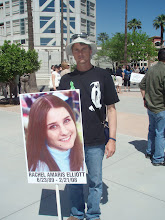
Showing posts with label bereavement. Show all posts

Sunday, March 18, 2012

3:31...

I lay with my eyes closed in the darkness, awake.


*


The day before I carried the obvious truth like a hidden wound, acting as if I could live with it, as if anybody could. We had lunch with family in my sister’s restaurant, Farwood Bar & Grill. Unless you already knew the story, you could not have guessed. And I did enjoy our time together, because I realize more than ever that every moment with those we love is precious. But I am living a double life: living with gratitude while carrying this grief. Maybe life is never simple, but always double, triple, multiple. I walked around all day, thinking, “Four years ago today, this was the last day Rachel walked this earth. What was she doing at this moment four years ago? What was she thinking? What was I?” Blissfully ignorant. Thinking it would go on like this forever, or something approaching it. That there would always be more time…


I had a dream or a vision, what ever you would call it. Rachel pulled up to the curb in her Honda. Jill and I were out working in the yard. I put down whatever was in my hand and walked toward her with wonder. Jill too. Rachel jumped out of her car and ran across the yard to meet us, beaming, delighted, I think, to surprise us. She had been gone a long time, and we weren’t expecting her. There was this beautiful moment of joy before the realization that she was really dead and I was only dreaming...


It always feels like a betrayal to be able to go on living. Those who know better will say that is unhealthy thinking. It is, I know. I turned 50 on February 6. Jill and I spent the weekend in the Anderson Valley to celebrate our 24th anniversary. We took the long way home, touring the wine country just waking into spring, and stopped at a couple of unique places to eat we had seen on Diners, Drive-Ins, and Dives. It was a beautiful weekend in every way. But I couldn’t shake the feeling that I was taking my leave, saying goodbye, likely never to pass this way again. I was painfully conscious that I was just passing through, that this strange and beautiful world...this life...doesn’t belong to me anymore, if it ever did. Though we mostly don’t behave like guests, but rather like we own the place and are trying our best to use it up, the truth is that we are only visiting here. But I suspect it is a dangerous mistake to let that keep us from forming attachments…


So, my birthday, February 6, was a Monday. We were stepping back into our routine after our extraordinary weekend. I wanted to be big about it, so I got out of bed as usual, made the coffee while Jill took her shower, and then sat in bed to read to her from the Daily Bible. As I read, a horrible awareness crept upon me: This was the passage we had read the morning Rachel was killed. I tried to read as if nothing was wrong, like I didn’t notice, but Jill stopped me to confirm the realization that was dawning on her, too. It was 5:00 a.m. and, after that, my day was already over...


Of course, I wonder about such coincidence. The day before, while driving through the wine country, different renditions of Amazing Grace had played back-to-back on the iPhone we were playing on shuffle through the car stereo. I asked Jill if she thought my smart phone was smart enough to know it was Sunday. Or maybe it was a sign?


We are haunted by the presentiment that maybe there is more to this life than the surface suggests. And tortured by the misgiving that maybe there isn’t.


The passage from Proverbs for that same day says, “The Lord directs a person’s steps. Why should we fret to understand every step along the way?” It’s true, I don’t know where I am going, so it is impossible for me to judge whether I am taking one true step in the right direction. Wiser souls would counsel me to let it go and simply let it be what it is. I’m not there yet.


Jill and I are reading Joan Chittister’s spiritual memoir, “Called to Question.” I am surely contorting the passage to fit my own interpretation, but she says, “Life is not about getting God. Life is about growing in God.” Presumably, we are all always in God, because there is no outside. She goes on to say, “We ripen. We learn. We hurt. We survive one thing after another. And we go on...in the end, we gain what we came to get...One way or another life batters us until we get the unavoidable. Sometimes we get it with glory; sometimes we get it in disgrace…” The God who is life inexorably teaches us. We learn what we need to know. We are not our own. We do not know who or what we are to become. We simply trust the process, and the God of life whom we can only hope controls it.


What kind of terrible faith is this?


The morning I woke up to that passage, I took it as a cruel cosmic joke.


That is the human problem, older than Job, with which those who suffer struggle: Is the God who guides the process loving, indifferent, or malevolent? Does God torture us for amusement? What are we to make of this mess?


The problem with my interpretation of events is that it flies in the face of the message of the passage. It is the passage in Ezra that affirms, “God is good. His faithful love endures forever.”


In spite of overwhelming evidence to the contrary, does love really guide the universe?


I have come to the conclusion that I over-reacted. I don’t blame myself. One emotional law I have learned is that in the absence of convincing proof to the contrary (and, really, what is proof?), the most loving explanation is correct. I guess you could call it the benefit of the doubt theorem...or the benefit of faith. If God really is good, as I have heard and still, tremulously, believe, and really does love me with a love that endures forever and transcends time and circumstance, then it is just possible that reading that passage on my 50th birthday was God’s way of telling me I am loved - in spite of everything.


As Theodore Roethke said, “I learn by going where I have to go.”


*


This morning, February 21, 2012, I awoke and kept my eyes closed in the darkness. When I finally opened them and looked at the clock it was 3:31 a.m. One minute after Rachel was pronounced dead four years ago. The beginning of the rest of my life…


“I wake to sleep, and take my waking slow.

I learn by going where I have to go.”

Theodore Roethke - “The Waking”

Sunday, February 26, 2012

PACING THE CAGE


I’ve had this feeling my whole life but increasingly lately: Claustrophobia.


I know what lies behind the door of Room 101. Being trapped in a tight place is my worst fear. As a kid, a friend locked me in a refrigerator as a prank. He had no intention of leaving me in there, and I knew that. Nevertheless, I freaked out. While in college I went spelunking with friends in the mountains above U.C. Santa Cruz. I only reluctantly followed them into the barren dark and barely contained my growing panic as we squeezed ourselves into places I imagined any number of ways to be inextricable. As part of my job as an electrician I must often crawl into attics and under floors. Sometimes I have to close my eyes, imagine myself somewhere else, take a deep breath. I don’t know why I watched the movie Buried. It was a nightmare. I don’t want to be buried, even when I’m dead.


My best dreams are flying dreams. I still think it is big mistake that human beings were not made to fly. I know we can, with machines. But I mean really fly. I am haunted by the line from T.S.Eliot’s poem, The Lovesong of J. Alfred Prufrock:

I should have been a pair of ragged claws

scuttling across the floors of silent seas.

All that space above, and here I am stuck to the floor of the earth, crawling around like a bottom feeder. Flying feels so right and natural in my dreams…


I’ve been experiencing a growing anxiety, a rising sense of panic. I feel trapped on this earth, imprisoned in this flesh. Rachel is unreachable, and that evokes a feeling of helpless, inescapable confinement. I rise in the middle of the night, get out of bed, and walk around to shake off the chains. I look at the stars. But even all that space seems only an elaborate cage. Make it as large as you can, I still feel imprisoned.


Jill’s sister Lindsay and her family came up to visit us to ease the difficulty of the 4-year anniversary of Rachel’s death. We did something we had been wanting to do for years. Lindsay and Rachel shared a love of large cats. We took Lindsay to the Barry R. Kirshner Wildlife Sanctuary, which houses an amazing collection of large, exotic cats. They are kept for their own good. For one reason or another, they could not survive in the wild. But that truth cannot be impressed upon them. When they are not sleeping, they restlessly pace the confines of their cage. It reminded me of the poem by Rainer Maria Rilke, called, The Panther:


His vision, from the constantly passing bars,

Has grown so weary that it cannot hold

Anything else. It seem to him there are

A thousand bars; and behind the bars, no world…


Rationally, I know that physical limitations define the terms of our freedom. We have five senses with which to perceive. But this feeling nips constantly at the back of my mind: what do they exclude? Perhaps they permit me only to perceive the prison, but not the real world beyond this captivity for which my heart yearns...


That night I had a dream: I was told that I would live to be 100 years old. The longevity that to most people may have been welcome news, seemed to me a cruel, intolerable sentence. 50 more years without Rachel. Another lifetime. In a reverse Hezekiah (2 Kings 20) I turned to the wall and wept inconsolably. I cried in anguish, “God, it’s too much… I cannot do it…” .


Sometimes you feel like you live too long.

Days drip slowly on the page.

You catch yourself

Pacing the cage.

Bruce Cockburn, “Pacing the Cage”


"Deep down I can't manage to become attached to this monkey-cage frenzy people so dramatically call life."

Rene Daumal, "Mount Analogue"


Life, just life is never

miracle enough no matter

how we try to church ourselves

Samuel Hazo, "For Anna Catherine On Thanksgiving"


This is not a death wish, but the acknowledgement of a restless, holy longing I think we all feel sometimes. I will wait. There is so much more to the story...

Monday, January 2, 2012

Snapshots Along The Way


Here are few snapshots of the past few months:


Jill and I went Christmas shopping, and had a pleasant enough experience. We decided to have lunch at Chili’s. At a table near us, a family was having a birthday celebration for their college age daughter. They sang happy birthday. Her name was Rachel. Of course it was…


When we traveled to southern California for Christmas we passed a car with a bumpersticker that read: “Freedom Isn’t Free. My grandson died for it!” In a way, Rachel, too, died for the sake of freedom: The freedom to drink and drive. No one celebrates her heroism, though. True, she did not choose her sacrifice or volunteer to put herself in harm’s way. With no greater protection than her blind faith in the goodwill of her fellow drivers, she took her chance, as we all do, every day. Now look at us. God bless America...


I get Google alerts for “DUI Homicide”. I don’t read them anymore. It is the same sad, maddening story every day. Nothing has changed. Rachel is dead. The world wasn’t impressed enough to change. How many more Rachel’s it will take until it does, I am too sick to reckon…


Two days before his 21st birthday, our son, Erik, and his friend, Amanda (whose boyfriend Aaron was killed in a drunk driving incident), were rear-ended at an intersection by a 17 year old girl. The impact propelled his car into middle of the intersection. Fortunately, nobody was crossing at the time. His car was totaled, though. The driver’s mother, who carried the insurance, is underinsured and will not cover the cost of replacement. Happy Birthday! Jill and I were in Chico that night, going to see the movie, The Way, by Emilio Estevez, about a man who carries his son’s ashes as he finishes his son’s pilgrimage to Santiago de Compostela. Erik didn’t have the heart to call us that night. He waited to call us in the morning until he knew we would be home from church. Another phone call. Another reminder of the fragility of life, of how slim the thread by which all our hopes hang...


No Christmas tree. No holiday music. A pile of cards stacked on the dining room buffet were the only evidence of the season inside our house. We didn’t have the heart for it, and because we were going to be in southern California, we had a good enough excuse not to make the effort. We put up a wreath and lights outside. Any casual observer would never know there was a completely dispirited couple making a show of life inside. True, it wasn’t as dreadful as it has been. I don’t know if we are showing signs of improvement, though. We were numb, indifferent, going through the motions. Merry Christmas!...


Dispirited. I received an email invitation from the Abbey of the Arts to consider seeking out a word that would guide my spiritual direction for the coming year. The word that was given to me is: “dispirited.” Hardly encouraging. But true. I recognized the truth of it the instant I heard it, and, as I lay on my bed listening, I heard it all night long. So there was no mistake. It’s not as bad as it sounds, though. It’s necessary first to acknowledge the problem, to find the starting point, before we can take a step in the right direction toward wholeness. Jill and I have already begun to do that. I don’t know where it will end. By the grace of God, the grace of God…


Some of Rachel and Erik’s friends visited us while we were down south. There was a moment when two of Rachel’s friends were sitting on the sofa with a space between them, and I had the distinct thought: Rachel should be sitting right there in that spot, laughing with her friends, discussing her job, her school (no, she would be finished with school by now), her boyfriend (or husband, or child…)with them. I let it go. I tried to be thankful for the gift of the presence of those who were there in the moment. A step in the right direction. Still: How much more beautiful the world would be if only Rachel were here…


I had to get out of the house, so I revisited Mt. Rubidoux. I walked to the cross at the top of the mountain to watch the sun rise. I went seeking something, but I did not know what I wanted. Though I did not receive anything tangible, I did come away with the conviction that many other seekers have walked the same path up the mountain with a heavy heart. I found signs along the way...


The cross is a holy emblem that reminds us of a noble act and a sacred idea. But as I observed the birds, the coyotes, the people on the mountain that morning, I had to acknowledge that they were no less holy than the cross I had made the goal of my pilgrimage.


I am reading Charles Frazier’s Thirteen Moons. The protagonist describes a Native American he knew, called Bear: “Bear loved all the tangible manifestations of Creation as fervently as Baptists do King Jesus. It was not the spirit of winds, rivers, mountains, trees that he worshiped, it was the living things themselves.” The living things themselves... The phrase resonates. One of the things I have come to appreciate more painfully than I ever thought possible is just that: the unique and irreplaceable precious life of each individual. The holiness of life expressed in every particular. Rachel is just one of the billions of humans that have ever lived. There has never been and there will never be another. How is it possible to live with the loss of something so uniquely precious? That is what I am dying to find out…

Monday, August 8, 2011

SENTENCE


We thought it would be a huge relief when the trial had concluded. There was a month between the end of the criminal trial for Elva Diaz and the sentencing hearing on August 5, 2011. We had to be away for two weeks for the trial, and when we returned home, we found that we had a lot of catching up to do: the bills had piled up, the garden and the yard was overgrown, and the to do list had increased at work - urgent demands all vying for our attention. We found ourselves unexpectedly stretched thinner than we had been in long time.


To add to our distress, we were tasked with writing a Victim’s Impact Statement. We had known for three and a half years that the day would come when we would need to submit one. And we have dreaded the prospect for as long as we have known about it. How could we possibly hope to articulate what Rachel means to us? How could we describe the kind of person she was? How could we convey how her death has impacted us? Multiply them as we may, we knew mere words could never bring Rachel to life. Every attempt to capture her essence, the depth of our pain, or the quality and magnitude of our love is doomed to failure.


Sentencing. Making a sentence. A sentence is something meaningful - but it is also an artificial construct, a symbolic approximation of truth, an interpretation of reality at some remove. For us sentencing meant making a declarative statement of our love and our loss of Rachel, however inadequate it may prove to be


Our Victim’s Impact Statements were to be read and considered by the Probation Department for sentencing recommendation and by the judge for sentencing determination. We invited anyone affected by Rachel’s death to submit a statement. We never knew how much our words might influence the actual decision making process, but we hoped, at least, to impress upon those who read or heard them what we all have lost in losing Rachel. A surprising number of people - over 30 in all - submitted statements. Each one captured something unique about Rachel and her impact on the person who wrote it. Jill compared the final package we put together to a multifaceted jewel, each perspective revealing a slightly different aspect of Rachel - the whole an impressive thing of beauty. Reading them was an intense emotional experience for us, and we will treasure each one as a precious gift for as long as we live.


We were surprised both by who did and who didn’t submit statements. We don’t resent those who didn’t, because we understand the difficulty and futility of the task. Some people tried and never succeeded in finding words. Some people were silenced from the outset by the overwhelming impossibility of the task and never actually put pen to paper (or finger to keyboard, as the case might be). I sat down at the computer one Saturday morning with much fear and trembling, not knowing whether I would be able to find the words or not, fearing that I wouldn’t. I was nearly paralyzed with anxiety, panic increasing as each moment passed, trying not to entertain the idea of failure, powerless to banish the thought from my mind. I didn’t want to let Rachel down. Early on, as I had imagined the task, I fantasized about my statement being the best thing I had ever written (since it was without question the most important). But, mercifully, I realized that was unrealistic, demanding too much of myself, and I settled for just getting the job done with some degree of authenticity. I accepted that my words would be inadequate and that my love for Rachel could never be satisfactorily expressed. I gave myself the freedom I needed to hazard the attempt and to fail.


In the end, I did write a statement only four typed pages long. I can’t judge whether it is good or bad, adequate or inadequate. I was just relieved I would have something to read to the judge in Elva’s presence at the sentencing hearing. Jill’s statement was 12 pages long, and that was not enough to say all she wanted to say. Judge Mark Johnson was touched by the words of the eight people who read their statements in court, though, and it was clear by his bearing that he sympathized both with our loss and the difficulty of our task. To him, Rachel was as real as our pain. That he understood what we had lost is a surprising source of comfort to us. For that, more than anything else, we are grateful.


A sentence is finite. We understand endings. A sentence is a punishment with an end in sight. For Elva, the sentence put a period on the term of her punishment. It is, I suppose, ultimately a hopeful thing. There will be a predetermined end to the unpleasantness of the legal consequences for her crimes. Judge Mark Johnson sentenced Elva Diaz to the upper or “aggravated” term for Gross Vehicular Manslaughter. Ten years. Perhaps, in the bewildering calculus of the legal system, three or four years with credit for time served. Now Elva Diaz knows how long she will have to suffer.


But it is not so for us. Our sentence is indefinite and continues on for as long as we can imagine the future. A run-on sentence. It never really makes a point, never reaches any sensible conclusion...

Wednesday, June 29, 2011

God On Our Side*


The courtroom is a strange congregation. I am reminded of nothing so much as a wedding, where the attendants are seated according to their relationship with either the bride or the groom. Only this isn’t a wedding. We avoid eye contact across the aisle. It is rather a somber assembly -. more somber, perhaps, even than a funeral.


Like a funeral, one of the principal players is conspicuously absent: the victim, namely, Rachel.


We have dreaded the day of the arrival of the trial since we learned that Rachel had been killed by a drunk driver. We knew it was coming. It took 3 years, 4 months, and two days to come to fruition - long enough for Rachel to have graduated college; long enough for her friends and contemporaries marry and have children of their own.


When Jill and I finally got the news that the actual trial date was confirmed, our hearts started pounding in our chests. We tried to use techniques we learned in yoga, breathing deeply and consciously to relax and calm our troubled hearts enough so that we could sleep. We both lay awake in bed all night, feeling our hearts pounding out their distress signals through the mattress. We wondered if they could keep the pace through the night or if they would simply giving out from exhaustion. It’s a strange thing: I didn’t think my mind was overly anxious - I told Jill and reminded myself that this was Elva Diaz’ trial, and not ours. But somehow our bodies were unconvinced by our reasoning.


We haven’t experienced such a bodily reaction since the first weeks after Rachel was killed. We felt as we did when we planned, attended and spoke at Rachel’s memorial services. Only this time the terms under which Rachel could be mentioned were scrupulously regulated: No mention could be made that the trial began on her 22nd birthday. No representations of her image or her name could be visible. A friend of Rachel’s who got a tattoo in her honor was forced to cover it up.


Strangely, though, once the proceedings began, Jill and I felt better. Our hearts slowed to something approaching their normal rate. We were able to sleep. Perhaps the anticipation really was worse than the reality, as with so many odious things in life. Perhaps there is something about the mind-numbing mundanity of the judicial process that makes what would normally be intolerable possible to endure. Perhaps, even this is a blessing.


It is out of our hands, now. Though how much we have ever been in control is questionable. There is something pacifying in the knowledge that whatever could be done has been done and that all that is required of us now is to show up and witness the proceedings.


Not that it has been easy to sit quietly while the facts have been intentionally distorted, confused, and covered up, while those who have sworn before God to tell the truth, the whole truth and nothing but the truth have done no such thing. Not in every case, but often enough that I can feel the anger rise in my chest like a fist. I swallow hard and keep my mouth shut.


But we have been strengthened by those who have sat beside us day after excruciating day. And we know that those present with us in court represent only a small portion of a much vaster congregation of love, present to us and for Rachel in the ways they are able. One dear friend who could not attend the first day of trial described to us how she had got on her knees in the restroom at work to pray for us as the trial began. Many who hardly know us but who have been touched by Rachel’s story and share our pain, have sent encouraging cards and emails, assuring us of their loving thoughts and prayers. All I can say is that we are truly, truly, humbled and grateful. I feel I owe a debt of love I can never hope to repay. And that has given me a new appreciation of grace.


On Sunday evening we decided to walk the trail to the cross at the top of Mt. Rubidoux. We shared the trail with more people than I imagined. It felt like a pilgrimage. There was a celebratory atmosphere, and an infectious fellowship that made perfect strangers exchange pleasantries and make small talk as we made the ascent. We shared a higher purpose, a common aspiration - making it to the top of the mountain.


We reached the summit just about sunset. The view from the top was spectacular, with a 360 degree view of the Riverside area, so often obscured by smog. Families mingled at the cross and read the inscriptions left in honor of Father Junipero Serra and other local historical dignitaries. We spotted lizards and kangaroo mice. We watched the sun drop behind the coastal mountain range.


In the failing light, we made our descent. The mountain was covered by or made up of huge boulders. On one boulder near the top I saw chiseled into the rock an inscription of the words of Jesus: “Let Not Your Hearts Be Troubled...” Jesus spoke those words to his disciples when they received the distressing news that he would be leaving them soon. It was a boulder such as this that sealed their Lord’s tomb, and, against which all their hopes were dashed. But after it was rolled away, the boulder was transformed into another affirmation of God’s ability to overcome any obstacle and to keep his word. Countless people around the world have taken courage from the words written on this rock over the millennia and no doubt thousands have been inspired by them on their way up to or down from the cross on the mountain. Still, they spoke personally to me, again. I took the message to heart.


The following day, as were seated in our places in court, Jill turned to me and said, “Ray is here.” I didn’t understand. I didn’t know who she was talking about. I turned to see my dear friend, Ray Houle, who had traveled all the way from Connecticut to share this difficult ordeal with us. I couldn’t have been more surprised or pleased if God had dispatched an angel straight from heaven. In every way that really counts, I suppose he did.


I’m not saying God or the universe is on our side. I recognize that each person in the courtroom is a precious child of God, and he has no favorites. I have consciously reminded myself of this as I have looked at each face present. Tomorrow, Thursday, June 30, the jury will be tasked with deciding Elva’s level of guilt for her crimes. The outcome is uncertain, and it is out of our control. But I know now more than ever that love is with us. And, since God is love*, that is enough.

Monday, June 27, 2011

HOME ALONE - RABBIT HOLE


We are in the midst of the criminal trial. I can’t talk about that now, as much for discretion’s sake as because I am at a loss for words. We want to hear the truth and expect justice will inevitably result. But, somehow, it seems, the process is not that simple...


I want to step back a little. A few weeks. Jill was away for a few days, attending another of the many pre-trial hearings in southern California. I encouraged her to stay through the weekend with her father at the cabin in the mountains near Lake Arrowhead that he and his wife have recently remodeled. Janet, his wife, would be away for the weekend, visiting her daughters, and it would be an opportunity for the two of them to spend some time together. From the front deck of the cabin, they could watch mountain bluebirds flit among the branches of the pine trees that grow just out of reach and feed the tree-squirrels that come to beg for the peanuts kept handy for their frequent visits. Time with her Dad, a change of scenery, the beauty of the mountains and the fresh air - Time well spent is good for the soul.


So that left me home alone. What does a married man, whose children are grown or gone do under such circumstances? I don’t hunt or fish or bowl or play poker. I tried to catch up on some reading. I dared to attempt to write. I watched movies I thought Jill would appreciate missing. Jill is long-suffering in her tolerance of my film choices, but every saint has her limits.


I watched “Rabbit Hole”. The film is adapted from a play by David Lindsay-Abaire. It is about a couple, played by Nicole Kidman and Aaron Eckhardt, who are grieving the death of their young son. Not exactly a feel-good movie. The disc had remained untouched for weeks in its Netflix envelope. I couldn’t find the right time to suggest to Jill that we watch it together. I knew that Mother’s Day wasn’t the right occasion...


The title of the film comes from a graphic novel that the young man who had the misfortune to unavoidably run over the little boy is creating. The premise of his graphic novel is that ours is only one of many possible articulations of the multiverse. Nicole Kidman’s character forges an unlikely friendship with the troubled young man, drawn to him out of the communion of their shared pain. She likes the beautiful idea that somewhere out there another version of herself is happy and her son is alive and well, though she doesn’t really believe it. It is another example of magical thinking. We all do it. Sometimes a little willing suspension of disbelief helps.


I was as inconsolable at times watching the film as the characters themselves. As painful as it was to watch - which is, no doubt, a testament to the authenticity of the writing and the skill of the actors - I found it to be ultimately encouraging. The bereaved parents do find a way to move tentatively and hopefully forward, individually and as a couple. We can’t imagine how they can possibly survive, and yet, somehow they manage. It forces us to marvel at the resilience of the human spirit and the power of love to persist in the face of seemingly overwhelming devastation.


The film is faithful to the real experience of grief. It doesn't exhaust the gamut of possible responses, but it does touch on the big issues and difficulties that grieving people deal with. It is honest enough not to offer cheap and unrealistic prescriptions.


There is no way to predict how the loss of a loved one will affect and reorder one's life and relationships. It is an emotional tsunami.


Those who have walked this road understand. We surprise and disappoint ourselves and others by our reactions and the often bewildering strategies we devise to survive. Some people get stuck. Some try to numb their pain with drugs or alcohol or sexual indulgence. Some withdraw and isolate themselves. Some look to find help in the company of those who have walked the road before them. Some surround themselves with mementos of their lost loved one's life, and some need to rid themselves of the unbearable reminders of what they have lost. Some couples are driven apart. Some become closer. Some embrace the comfort to be found in religious faith, others blame God.


In the film, Nicole Kidman’s character’s mother has also lost a child. The circumstances of the deaths are vastly disparate (one was a little boy hit by a car, the other a 30 year old man who overdosed). This is a source of some friction between the mother and daughter - but they learn to accept the fact that they do share the stark and inescapable fact of loss. I share a similar bond with my mother, though the circumstances of my sister’s and my daughter’s deaths are not so different: they both died in car wrecks when they were 18 years old.


The two women have a crucial and poignant exchange in the basement of the family home while they are storing the little boy’s belongings away to make it less complicated to sell the home:


Becca: "Does it ever go away? "

Nat: "No, I don't think it does. Not for me, it hasn't - has gone on for eleven years. But it changes though."

Becca: "How?"

Nat: "I don't know... the weight of it, I guess. At some point, it becomes bearable. It turns into something that you can crawl out from under and... carry around like a brick in your pocket. And you... you even forget it, for a while. But then you reach in for whatever reason and - there it is. 'Oh right, that...' Which could be awful - not all the time. It's kinda..."

[deep breath]

Nat: "not that you like it exactly, but it's what you've got instead of your son. So, you carry it around. And uh... it doesn't go away. Which is..."

Becca: "Which is what?"

Nat: "Fine, actually."


A year or so after Rachel was killed, Jill and I had dinner with a couple who had lost their own son in a motorcycle accident 10 years before. They were still alive. We couldn’t imagine ourselves in their place, 10 years down the road, without Rachel. We didn’t want to. In those days, our grief felt like a mountain had collapsed on us and we could not possibly dig ourselves out of the avalanche. If we could find the strength to dig, we didn’t even know which was was up. Our only hope, we thought, was rescue. We couldn’t help but ask the same question of our friends that Becca asked her mother: Does it get easier? Is there hope for us, down the road? Their answers were similar: “It never goes away. It does become more bearable. The emptiness you feel in Rachel’s absence is itself a presence that will never leave you. As improbable as that may sound to you now, it is strangely comforting.”

Saturday, June 18, 2011

The End of the Road


Today is June 18, 2011. Tomorrow is Father’s Day. Jill and I started the day out right, in our hot-tub, drinking our morning coffee. Afterwards, we had a quiet breakfast, reading the news, and then began to tackle the endless list of chores and minor projects to be done around the house. As we do so often, we turned on the radio and listened to NPR as we worked: we listened to This American Life, and a locally produced acoustic music program called Harmony Ridge. Both shows were appropriately topical, featuring stories and music that revealed and celebrated Fatherhood. I often moved about the backyard in a blur of tears.


Last night I dreamt of the house we lived in when we brought Rachel home from the hospital. Everything was different in my dream, as it would be in real life if we had the opportunity and heart to revisit it. The house was vacant, and as we walked around trying to decide whether or not to replace the carpet, I told Jill that I hand’t realized how much I loved our lives there - I wished I had known well enough to cherish it.


I acknowledge that some of what I feel is nostalgia and not pure grief. Rachel, even if she had not been taken away from us by a drunk driver, would be on her own, living her own life, and not with us. But, in my defense (not that I need to defend myself), I did my best to let go of Rachel when the time came, though my heart was not really in it. Selfishly, I wanted to forbid her to move to southern California to pursue her dream of becoming a forensic scientist. Sometimes, I wish I had been a selfish, overbearing father and pressured and manipulated her into staying close to home. If I had, she would probably still be alive. Does that make it right? It’s difficult in cases like this to separate the intent from the outcome. I think I could live with being a lousy father. I find it hard to live without Rachel, though, somehow, I must.


There is a poem by Ellen Bass that I read a few months after Rachel was killed. It is called “After Our Daughter’s Wedding.” The title is enough to bring me to tears. It describes a mother sitting on a lakeshore after her daughter’s wedding reception, weeping. Her partner asks her, “Do you feel like you’ve given her away?” No, she explains in the rest of the poem, she is weeping from relief that her daughter has survived to see this day, in spite of everything that can and so often does happen. She compares the perils of childhood to that of baby sea-turtle hatchlings hobbling across the beach, exposed under the moonlight - an image that reminds me of a harrowing scene from “Suddenly Last Summer,” where the vision of baby turtles being devoured on the beach by hungry gulls displaces the memory of the violent death of a young woman’s cousin. That movie horrified me, and the image from Ellen Bass’s poem resonates with every parent. As parents, our most basic, instinctual imperative is for us to deliver our children safely into adulthood. Sweet life. Survival. Every year I empathize with the worried birds that guard the yard as their fledgling offspring fresh from the nest test their wings...


I think I could be happy knowing Rachel was “Somewhere Out There,” even if I was denied ever seeing her again. And, to be honest, sometimes I have to pretend that is the case just to be able to survive another day. Just knowing that she is beautifully alive would be enough. I know, we always want what we can’t have...


This American Life featured stories of predictably distant fathers, fathers who could never find the words to say, “I love you.” Of course, it made me consider the kind of father I have been to my children. Clearly I wasted precious time on things that seemed so urgent to me then but, in hindsight, were not of primary importance: Making a living, paying the bills, a clean house, home improvement projects... In the end, love is all that matters. Recently Jill and I watched an episode of MadMen. Don Draper, a newly divorced father of two, seeks advice about his young daughter who is behaving strangely. He is justifiably worried about her. His female friend advises him that as long as his daughter is convinced that he loves her, she will be fine. I hope that is true. I know that love doesn’t make everything ok. But when all else fails, maybe it really is all we need. I hope Rachel was the remarkably confident, amazingly capable young woman she was in part, at least, because she could take her parents’ love for granted.


Thursday, June 23 will be Rachel’s 22 birthday. We have been getting graduation, wedding, and birth announcements from her friends. We are happy for them. We truly are. As much as we can be. Rachel should be here, passing these milestones, and we should be sharing her joy. Instead, we will be driving together as a family - me, Jill, and Erik - to be present at the criminal trial of the woman who killed Rachel. It appears that opening arguments will begin on Rachel’s birthday. Rather than holding our breaths while our daughter makes wishes for a happy future, we will be staring at the back of the head of the woman who killed her, as she tries to evade a reckoning for her crimes. We do not know if this is some kind of cruel joke, an auspicious sign, or maybe, just another one of life’s befuddling little ironies.


It has been a long road, and, I must say, quite a wild and horrible ride. Since February 21, 2008 we have known someday we would arrive at this destination: the criminal trial. It isn’t where we wanted or chose to go. For going on four years, the course of our lives has largely been determined by Elva Diaz - her choices and her actions. We look forward to putting this in our rear view mirror, and breaking the constraint Elva Diaz has on the course of our present life - though she has forever altered its shape and quality. We know that the end of the trial is not the end of the road. The road continues, and we must go on...

Saturday, May 14, 2011

The Swing of Life, or, Dance This Mess Around


Friday, May 13th was a typical day in the extreme, swinging from sorrow to joy.


Jill and I both went to work with a sense of dread. Not only was there yet another court hearing hanging over our head (this time on the defense’s motion to recuse the deputy district attorney, Kevin Beecham, who has been with us since the beginning of this ordeal) but Jill was scheduled to speak at Orland High School’s Every 15 Minutes program. Rachel graduated from Orland High School in 2007. The program was held in the gym where we chaperoned Rachel’s Senior Prom, where we sat through the difficult Every 15 Minutes program in which Rachel played the role of a DUI fatality, and where, a few short months later, we held her Memorial Service when Rachel was killed. Our family history haunts the place. Proud moments, happy memories and sadness. Simply walking into the building is an emotional roller coaster ride.


Jill was there to lay her heart bare by telling Rachel’s story. Many of those in attendance knew Rachel personally. Some of them remember her participation in the 2007 program. When Jill stood up to speak, the program ceased to be any sort of fiction. Everyone felt the gravity of the reality of the events portrayed. Everyone felt the pain of Jill’s heartbreak. It was almost too real, too much. I kept having to remind myself to breathe, as if not breathing might somehow keep me from falling apart completely. One of the hardest things I have had to endure is to watch my beloved’s heart break, knowing there is nothing I can do to stop or fix it...


You had to be there. The tears and the snot flowed freely as Jill described the events that led to Rachel’s death and the effect it has had on her and on us. People don’t get awards or medals for such things. Maybe they should. I have never witnessed a more courageous and selfless act in my life. I was in awe, and I think everyone else there was as well. I couldn’t peel my eyes off of Jill as she spoke. I was sitting in the front of the auditorium, so I couldn’t see the effect her words had on others. But, when we lingered after everyone else was gone, talking to people who were moved by Rachel’s story, I noticed that the floor of the gym was littered with wads of facial tissue. I wish I had a picture of it.


We were spent. Grief is physically exhausting. We went home afterwards, and climbed into bed. We slept for a while, and felt a little better when we woke. I suggested we grab an early dinner at my sister’s restaurant in town, Farwood Bar and Grill. It didn’t take much to sell Jill on the idea. Mary, our waitress at Farwood, told us that she had attended the Every 15 Minutes event. Because of some painful family history and difficult circumstances in her life, the event had a powerful emotional impact on her, and she told us she was wiped out. She marveled at our strength: She didn’t know how we could do it.


The truth is, neither do we. Before Rachel was killed, we were convinced we could not survive such an ordeal, and we marveled at those who did. We know we are not special or strong. The only explanation we have is that we do what we must. If we have any strength, it is faithfully supplied to us by the Lord simply because we need it.


We had tickets for a B-52’s concert. I remember the first time I saw the B-52’s back in the early 80’s on Saturday Night Live. I was disparaging, dismissive. They were silly. But over the years I grew to love the B-52’s because Jill does, and I love Jill. I bought tickets for the concert, hoping that it would give us something to look forward to beyond the difficult Every 15 Minutes event. We both almost regretted it. After the emotional wringer we had been through, we didn’t know if we had the energy to attend a concert an hour and a half away from our home that didn’t even start until 9:00 p.m.


We went anyway, trusting our instincts. I had bought general admission tickets - standing room only - because we wanted to dance. We had attended a B-52’s concert once before, years ago at Six Flags Over Texas, and security had strictly enforced a no-dancing policy. It was a cruel and unusual prohibition - and we resolved not to suffer it again. We got to the show a little early and staked out a place at the foot of the stage. From the opening beat, we abandoned ourselves to the music, looking and feeling foolish, a couple of aging empty-nesters thrashing out their heartbreak. It felt good. Silly and good. And even and as we danced I knew how silly it was to be dancing with my shattered heart barely held together by this slim thread of love. I really got it then. The B-52’s have known their share of heartbreak and pain - the death of Cindy Wilson’s brother, Ricky. But night after night they get out on stage and dance, dressed in their campy outfits, and sing their silly songs. They make people smile. They make people forget their pain - or dance in spite of it, dance in the face of it. It warmed my heart to see Jill laugh and smile and dance like she did when she was a girl, dancing and singing the silly lyrics of the B-52’s. I found myself fighting back tears even as I danced with abandon. Dancing with tears in my eyes. Joy and sorrow, despair and hope, love and heartbreak, holding hands, together. Dancing the swing of life.


I like to think that though Rachel would no doubt have been a little embarrassed by her parents, she also would have been pleased and proud that we choose to embrace life and its silly little joys, despite the pain.


After the show, Jill and I were tired, but refreshed - sweaty and thirsty and euphoric. We went looking for a place in the casino to get a milkshake for the long drive home. We walked past an older woman in a wheelchair, wearing a beatific smile on her face. She was reverently holding a pair of drumsticks. I recognized them from the show. One of the performers must have given them to her as he or she left the stage. I watched as the woman in the wheelchair took a picture of them with her cellphone camera and sent it off to somebody with whom she wanted to share her joy. I thought of the difficulty of her life, all she must have suffered, must suffer daily. But there she was - and she had received a gift she would have missed otherwise.


In the words of the B-52’s:


Dance this mess around.

Don’t that make you feel a whole lot better?

I’m just askin’


Saturday, January 22, 2011

AMUSEMENT


We finally took down the Christmas lights today. We were the last on our block. It’s not that our Christmas spirit is indomitable: we barely managed the effort to put them up in the first place. In fact, the Christmas lights and the wreath we bought from the Sober Grad Committee and hung outside the front door were all the show of enthusiasm for the holiday we could muster this year. For the first time in our marriage, we didn’t buy and decorate a Christmas tree. We simply could not do it. On Christmas Day, we escaped to the movies and saw True Grit. Movies are amusement: literally speaking, a diversion that causes you not to think.


The reason the lights stayed up until nearly the end of January is that we simply couldn’t find the energy to take them down. It was just easier to keep them burning night after night and let the neighbors believe we just couldn’t let go of the magic of the holidays.


Christmas is just one day out of the year, but it highlights and typifies the hideous transformation of our lives since Rachel was killed by a drunk driver.


It has always been my intention to articulate here the far-reaching consequences of one bad decision. The qualitative change of the character of Christmas for us is just one of the consequences. They are new every morning. The other night Jill and I sat on the couch and watched the season premier of American Idol. I fought back tears as I watched a 16 year old girl dedicate her performance to her loving father. I can’t even watch an inane T.V. program. Rachel was a beautiful singer, but her voice has forever been silenced...


Last weekend Jill and I went to the wedding of one of Rachel’s best friends from high school. Nearly three years have passed now since Rachel was killed. It’s that time: all of the young people she grew up with are graduating from college, getting married, making their own lives. What would Rachel be doing now? I got to watch the father of the bride walk his beautiful daughter down the aisle and trust her to the care of the man she loves and to whom she vows to devote the rest of her life. I can’t help but anticipate what comes next: children, grandchildren I will never know.


These are the brutal realities we must face day after day. We have to live with the realization that there will be no happy ending to our story. Rachel is not coming back. While we are conscious that we still have much (though much less) to be grateful for, we can’t escape that fact. As David said of his first son born to him by Bathsheba, “He cannot come to me, but I must go to him.” We can look forward to joining Rachel in death. Sadly, that is our fondest hope.


I haven’t written anything about the court proceedings, yet. Let’s just say they are going as expected. Elva is playing every card to keep herself out of prison for as long as possible, and her defense is playing right along. She has been in custody in county jail (not prison) since July (six months! - which, of course, will be credited to her as time served), and we still haven’t even had a Preliminary Hearing, let alone begin a trial. Our next court appearance is January 28, which occurs right between my Mom and Dad’s 50th wedding anniversary, and my Mom’s birthday. I get to miss them both to be with Elva Diaz in court. And I get to miss work and buy a plane ticket to pay for the privilege.